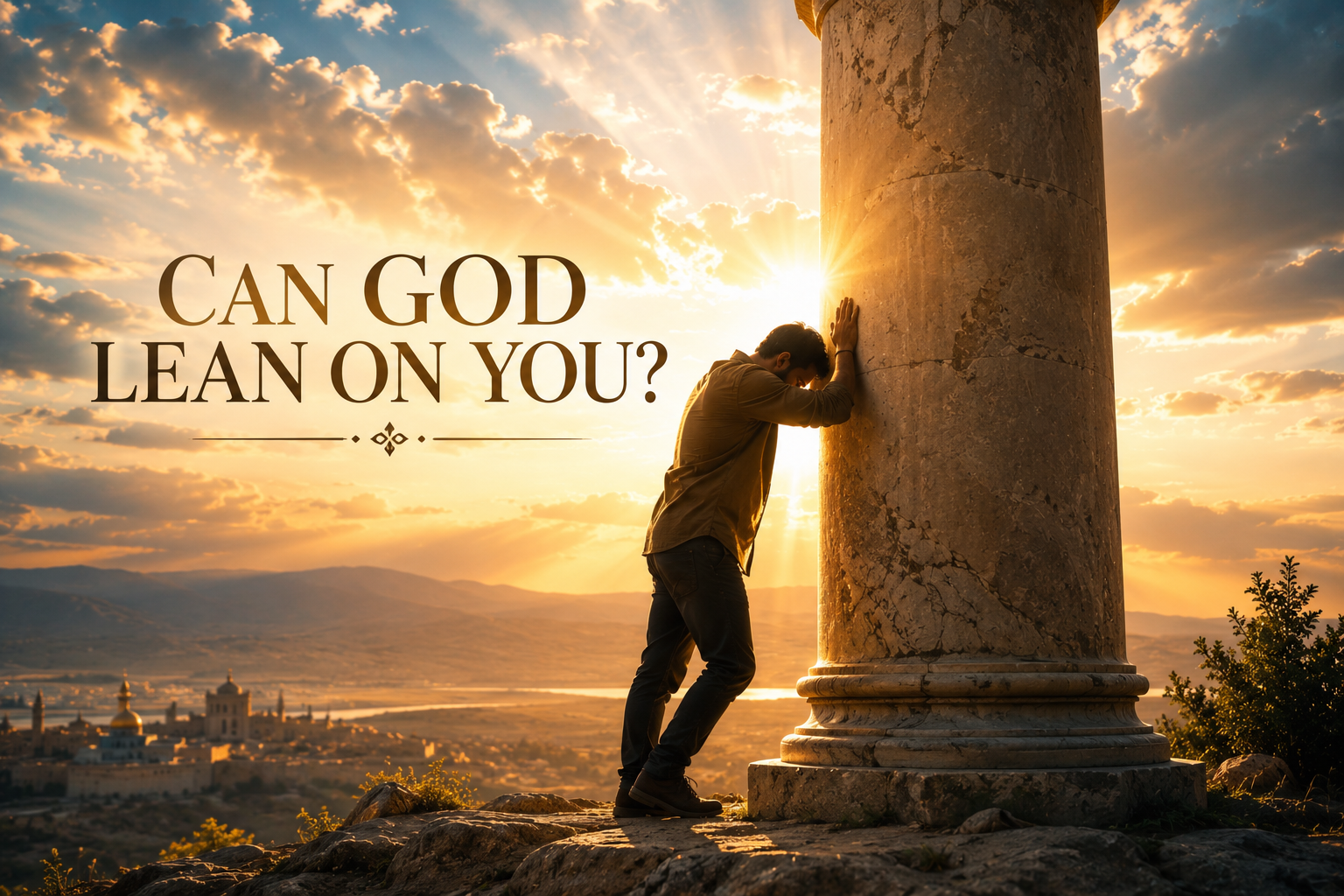
Can God lean on you?
Acts 3:13 (NIV) “The God of Abraham, Isaac and Jacob, the God of our fathers, has glorified his servant Jesus.”
The Weight Beneath Every Great Structure
In the heart of London stands St. Paul’s Cathedral, one of the world’s most admired landmarks. Millions marvel at its beauty and architecture, yet few think about what supports it. Hidden beneath the visible grandeur are pillars and foundations carrying tremendous weight. Remove them, and the structure eventually collapses.
The same principle applies to life. Strong families, healthy churches, and lasting ministries exist because someone quietly carried responsibilities that others rarely noticed. Every enduring work stands because someone was willing to bear the weight.
Scripture reveals that God’s kingdom advances in much the same way. Throughout history, God has used faithful men and women who became spiritual supports for His purposes. They were not always the most gifted or visible people, but they were dependable. They became what we might call covenant pillars—people upon whom God could build.
This raises an important question: not simply, “Can God bless me?” but rather, “Can God lean on me?”
More Than a Miracle
That question comes into focus in Acts chapter 3. Peter and John encountered a man who had been crippled from birth and sat daily at the Temple’s Beautiful Gate begging for alms. Everyone knew him. Everyone knew his condition.
When Peter declared, “In the name of Jesus Christ of Nazareth, walk,” the man was instantly healed. Strength entered his feet and ankles, and he began walking, leaping, and praising God.
The crowd gathered in amazement.
Yet Peter did something surprising. Instead of focusing on the miracle, he focused on God.
“The God of Abraham, Isaac and Jacob … has glorified His servant Jesus.”
The crowd saw a healed man. But Peter saw something deeper.
The miracle was not the destination. It was a signpost pointing to Jesus Christ. Peter wanted the people to understand that the God who called Abraham, preserved Isaac, transformed Jacob, and guided Israel throughout history was the same God who had glorified Jesus.
The Covenant Hidden in a Name
Why did Peter use the title “The God of Abraham, Isaac, and Jacob”?
Because these names represented far more than three individuals. They represented God’s covenant faithfulness across generations.
When God appeared to Moses at the burning bush, He introduced Himself as:
“The God of Abraham, the God of Isaac and the God of Jacob.” (Exodus 3:6)
Later He declared:
“This is my name forever.” (Exodus 3:15)
Remarkably, God chose this covenant designation as His memorial name. He repeatedly identified Himself through these men because they were the carriers of His promises. They were covenant pillars. Through them God’s redemptive plan moved forward until its fulfillment in Jesus Christ.
The People God Builds On
A pillar exists to support something larger than itself.
Throughout Scripture, pillars symbolize stability, strength, permanence, and support. Paul even described James, Peter, and John as:
“Pillars” of the early church. (Galatians 2:9)
A covenant pillar is a person whom God can trust to carry His purposes from one generation to the next.
Such people may never gain widespread recognition. Their names may never appear in books or headlines. Yet their influence extends far beyond their own lifetime because they faithfully support what God is building.
The kingdom advances through faithful people more than famous people. God is looking not merely for ability but for availability, dependability, and obedience.
Abraham: Faith That Walks Before It Sees
The first covenant pillar was Abraham.
“Abram believed the Lord, and he credited it to him as righteousness.” (Genesis 15:6)
Abraham trusted God before seeing the fulfillment of God’s promises. He obeyed before understanding all the details. He left the familiar without knowing his final destination. Faith became the defining characteristic of his life.
In our culture that demands certainty, Abraham reminds us that God’s greatest works often begin with trust. Faith is not having all the answers. Faith is obeying when all the answers are not yet available.
For young believers especially, Abraham teaches that God often reveals the next step before revealing the entire journey.
Isaac: The Ministry of Staying Faithful
If Abraham represents faith, Isaac represents continuity.
Isaac did not originate the covenant. His assignment was to preserve it. God reaffirmed Abraham’s covenant to him and called him to continue what had already begun.
This may not seem as dramatic as Abraham’s calling, but it is equally important. Many people can start something. Far fewer can sustain it. Many want to pioneer. Few want to preserve.
Yet churches, families, and ministries survive because faithful men and women quietly continue the work entrusted to them.
Pastors, parents, teachers, and leaders should never underestimate the ministry of staying faithful.
One of the greatest gifts you can give the next generation is consistency and faithfulness. Our children will admire us for our consistency and faithfulness. Someday in their lives, they may thank God for these two qualities in us.
Jacob: Broken Before Being Built
Jacob’s story offers hope to imperfect people.
Unlike Abraham, Jacob’s life was marked by struggle, failure, and wrestling. Yet God was not finished with him.
At Peniel, Jacob encountered God in a life-changing way.
“Your name will no longer be Jacob, but Israel.” (Genesis 32:28)
Before God expanded Jacob’s influence, He transformed Jacob’s identity.
This remains God’s pattern today.
Before public usefulness comes private formation. Before greater responsibility comes deeper surrender. Before God builds a pillar, He often shapes the character of the person who will carry the weight.
Many believers see difficulties as interruptions. In reality, some of God’s greatest work occurs in seasons of testing. The very pressures we seek to avoid may be the tools God uses to prepare us for greater usefulness.
Building for a Future You May Never See
One characteristic united Abraham, Isaac, and Jacob.
“One generation commends your works to another.” (Psalm 145:4)
The covenant moved from Abraham to Isaac, from Isaac to Jacob, and from Jacob to future generations.
A covenant pillar thinks generationally.
Such people build for a future they may never personally witness. They plant seeds knowing others will enjoy the harvest. They invest in people who will carry God’s work beyond their own lifetime.
Abraham never saw the nation Israel become what God promised. David never saw Solomon’s Temple completed. Yet both invested faithfully in a future beyond themselves.
That is kingdom thinking.
Pillars in an Age of Platforms
Our culture celebrates visibility. Social media rewards attention. Success is often measured by influence, popularity, and public recognition.
God measures differently.
The Lord is not merely looking for people with platforms. He is looking for people who can carry weight.
- Platforms attract attention.
- Pillars carry responsibility.
- Platforms may last for a season.
- Pillars support generations.
The church’s greatest need is not more personalities but more people whose lives possess the depth, character, faithfulness, and endurance necessary to support God’s purposes over the long haul.
From Stone Pillars to Living Pillars
One of the beautiful themes in Scripture is the progression of pillars.
Jacob erected a pillar at Bethel after encountering God. Solomon’s Temple contained magnificent pillars symbolizing God’s presence. Paul referred to church leaders as pillars.
Then Jesus made an extraordinary promise:
“The one who is victorious I will make a pillar in the temple of my God.” (Revelation 3:12)
In Genesis, people built pillars.
In Revelation, God builds pillars.
The stone pillars of Scripture stood in one location. The living pillars God builds stand through generations.
Can God Lean on You?
Ultimately, the question is not whether God desires to bless us. Scripture repeatedly affirms His love, grace, and generosity.
The deeper question is whether God can trust us.
- Can He trust us with influence?
- Can He trust us with responsibility?
- Can He trust us with people?
- Can He trust us with His purposes?
When God finds a man or woman who remains faithful through trials, disappointments, delays, and seasons of testing, He does more than bless them. He builds upon them.
And when God decides to build upon a life, that life becomes more than successful—it becomes significant.
The world may never know the names of many covenant pillars. Yet eternity will reveal that some of God’s greatest works stood because faithful men and women quietly carried the weight.
Perhaps that is God’s invitation to us today—not merely to enjoy His blessings, but to become the kind of people upon whom He can build.